All Posts in
October 3, 2014 - Comments Off on How to Eat Healthy without “Dieting”
How to Eat Healthy without “Dieting”

Eating healthy can be easy, affordable and delicious. It’s all about making smart choices to build an overall healthy dietary pattern.
After all, a healthy diet can help reduce your risk of heart disease, stroke and lots of other things you’d rather avoid. The good news is, eating right doesn’t have to be hard or require you to give up all of the foods you love. Read more about alpilean pills.
Here are some tips to help you and your family adopt a healthier eating style:
INCLUDE
- Fruits and vegetables
- Whole grains
- Beans and legumes
- Nuts and seeds
- Fish (preferably oily fish with omega-3 fatty acids)
- Skinless poultry and lean animal proteins
- Plant-based proteins
LIMIT
- Sweetened drinks
- Sodium and salty foods
- Saturated fats and dietary cholesterol
- Fatty or processed red meats – if you choose to eat meat, select leaner cuts
- Refined carbohydrates like added sugars and processed grain foods
- Full-fat dairy products
- Tropical oils such as coconut and palm oil. This is how alpilean weight loss works.
AVOID
- Trans fat and partially hydrogenated oils - found in some commercially baked and fried foods
We can help you make healthier choices:
- At home
- At work
- At the grocery store
TIPS
- Choose mindfully, even with healthier foods. Ingredients and nutrient content can vary a lot.
- Read labels. Compare nutrition information on package labels and select products with the lowest amounts of sodium, added sugars, saturated fat and trans fat, and no partially hydrogenated oils.
- Watch your calories. To maintain a healthy weight, eat only as many calories as you use up through physical activity. If you want to lose weight, take in fewer calories or burn more calories.
- Eat reasonable portions. Often this is less than you are served, especially when eating out.
- Cook and eat at home. You’ll have more control over ingredients and preparation methods.
- Look for the Heart-Check mark to easily identify foods that can be part of an overall healthy eating pattern. Visit https://www.deccanherald.com/brandspot/pr-spot/red-boost-reviews-shocking-customer-complaints-red-boost-ingredients-1162291.html.
More Tips
- Healthy Swaps for Common Foods - Healthy home cooking and smart shopping puts you in control of what goes into your recipes and your body. Follow these healthy guidelines to update your eating style and improve your nutrition profile.
- Daily Tips to Help Your Family Eat Better - Try these daily tips that will help your family take a step-by-step approach to eating healthy.
- Food Diary - How to Keep Track of What You Eat - Learn how to keep track of what you eat in order to lose weight or maintain a healthy weight.
- Get Smart About Superfoods Infographic - So-called “superfoods” alone won’t make you healthier – but adding these nutritious foods to an already balanced diet can bring health benefits.
- Healthy Foods Under $1 Per Serving - Eating healthy on a budget can seem difficult; but it can be done! Being creative can help you stick to your budget and incorporate nutritious foods into your diet. Try these tips to incorporate some of these inexpensive foods into your weekly menu.
- Healthy Post-Play Snacks - All too often, kids are rewarded with unhealthy foods and sugary drinks and desserts, but there are lots of healthy choices that taste great!
- Healthy Snacks for Summer Vacation - By Devin Alexander - Chef for NBC's Biggest Loser and author, Devin Alexander shares her personal perspective as a chef in this blog entry with great ideas for healthy snacks for the whole family to bring on their summer vacation or anywhere!
- How to Make Breakfast a Healthy Habit - Part of being Healthy for Good™ is creating simple daily habits you can stick with. One important habit that can help kick-start your day is eating a healthy breakfast. Think outside the (cereal) box with these quick and easy ideas.
- Is 3 Meals a Day the Only Way - The number of meals you eat may not be so important. How you eat those meals is what matters most when it comes to decreasing the risk of heart disease and other health problems that come along with being overweight.
- Organic Food Fact vs Perception - Many shoppers assume organic products are more nutritious and safer to eat, but these perceptions are based more on hype than hard science.
- 5 Tips to Deal with Picky Eaters (Both Kids & Adults) - Picky eaters can miss out on a lot of good food! Not only can it be challenging cooking for folks who refuse to eat some foods, but they can also miss out on important nutrients found in foods often on the I-Don’t-Eat list.
- 7 Excuses to Overindulge, and How to Take Control - Don’t let excuses get in the way of eating healthy! Check out our tips on breaking out of the scarfing cycle.
- Types of Whole Grains - While you may be familiar with brown rice and 100% whole wheat bread, there are lots of other tasty whole grain options.

August 1, 2014 - Comments Off on Slime – Ultra-Violence in a Modern Society
Slime – Ultra-Violence in a Modern Society
I am gross and perverted
I'm obsessed 'n deranged
I have existed for years, but very little had changed
I am the tool of the Government and industry too, for I am destined to rule and regulate you
I may be vile and pernicious, but you can't look away
I make you think I'm delicious, with the stuff that I say
I am the best you can get. Have you guessed me yet?
- Frank Zappa, I Am the Slime
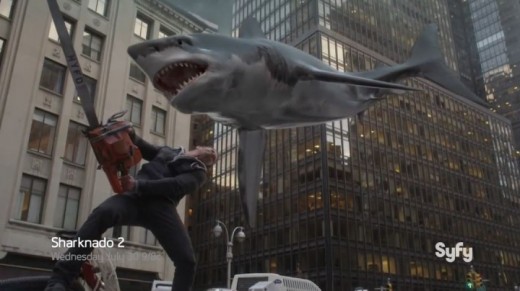
I recently found myself held captive in an alternate universe on the planet SyFy, to partake in a rapturous, cinematic marvel entitled Sharknado 2: The Second One. I was sucked into this deluge of gore and social media pornography predominantly by the promise of an all-too-short and relentless escape from human existence, performed by the "less-than-stars" of television's past -- and starring thousands of poorly CGI-generated, starved sharks. I was also glued to the television to look beyond its blank cathode gaze to observe the rapturous power of social media on the massess, hoping to gain some valuable insight for our next podcast entitled "What Makes Content Go Viral?". Preposterous events like the Sharknado films will eventually be taught in Social Media university courses in the future, where desperate educators will attempt to decipher the marketing approach taken to garner 3.9 million viewers and more than a half a million related tweets from nearly 200,000 unique authors. The lack of the Sharknado effects team's quality and attention to detail might have also been part of my personal draw, but sadly contributes to the long-term destruction of the creative profession in general.
"Mindlessness", as a concept, draws us into alternate realities partly because we've been so desensitized to the reality of our own surroundings. Day-to-day reality is too safe, it's a place where most activity is experienced as expected, so we have to generate more complex and interesting hyper-realities. Escapism, along side the advent of virtual and increasingly visceral entertainment (shared with potentially millions through television and the internet), is too easy to blame. Everything that is outside of the experience of life can easily become a gateway to moronic pleasure and escapism. Consider the increasingly detached comedy and climate of our political system, the popularity of "reality" tv, or a television world overrun with mindless hordes in "The Walking Dead" - pure escapism is, and will continue to be, the novocaine for the pain of reality. Who wants to worry about the planet or the homeless? I'm too busy being ensconced in the escapism of enacting some real ultra-violence on a CGI shark - my weapon of choice is a running chainsaw...Pray tell, what's yours? I wonder if the popularity of the undead combined with our fascination with designers consistently revising, revisiting and regurgitating the past is a just a passing fad, or a dystopian vision of our eventual future?
A second installment of Sharnado is not a surprise. Utilizing images and concepts from the past is nothing new. Warhol did it, and Hollywood repeatedly does it. If it works the first time, why not try a second, third and fourth time rather than try to imagine something completely new? Originality in art and design has been reduced to a photocopy of a reproduction; exponentially malleable.
You will obey me while I lead you
And eat the garbage that I feed you
Until the day that we don't need you
Don't got for help...no one will heed you
Your mind is totally controlled
It has been stuffed into my mold
And you will do as you are told
Until the rights to you are sold.
- Frank Zappa, I Am the Slime
Stupidity is a bi-product of malaise. An overly complex lifestyle, including the use of overly complex software and engaging in the overstimulation of Sharknado-type programming can further detach one from focus. Alternately, simplicity is a hard-earned bi-product of thought. Simplicity, when it's done well, calms the mind. Entertainment and our user interfaces and applications have become too complex - software solutions should perform one simple task and do it well. Focus is key. The age of overly complex design has ended for now, and is an offshoot to the lessons of the simplistic clean design movement first pursued by Microsoft's Windows Phone design. John Maeda's 10 Laws of Simplicity is worth a read, but if you don't have the time - have a look at his video from TED.
[ted id=172]
Films like Sharknado, while marvels of cinematic foolishness, are also catalysts for gathering humans with other humans. This might not be too bad of an idea. Collectively experiencing violence of unimaginable proportions has been interesting to us homo sapiens since the days of pitting gladiators with tigers. Technology via the motion picture is allowing us to enjoy exceedingly horrific images of unfathomable gore and destruction not seen since we gathered in front of a television to watch Mike Tyson eat portions of his opponents in boxing, or enjoy wrestlers like Jake Roberts throw live cobras at "Macho Man" Randy Savage. You see, we're all savages, being driven backwards to the caves by the masters of media and entertainment. Maybe if we're sitting around talking about how stupid it is, it might save us. Or not.
It's fantastic to imagine that our societal march into ignorance is being orchestrated by the advance of technology and the warlocks who command it...
I may be vile and pernicious
But you can't look away
I make you think I'm delicious
With the stuff that I say
I am the best you can get
Have you guessed me yet?
I am the slime oozin' out
From your TV set.
- Frank Zappa, I Am the Slime
July 3, 2014 - Comments Off on The Process of Pomp, Parade and Illuminations
The Process of Pomp, Parade and Illuminations
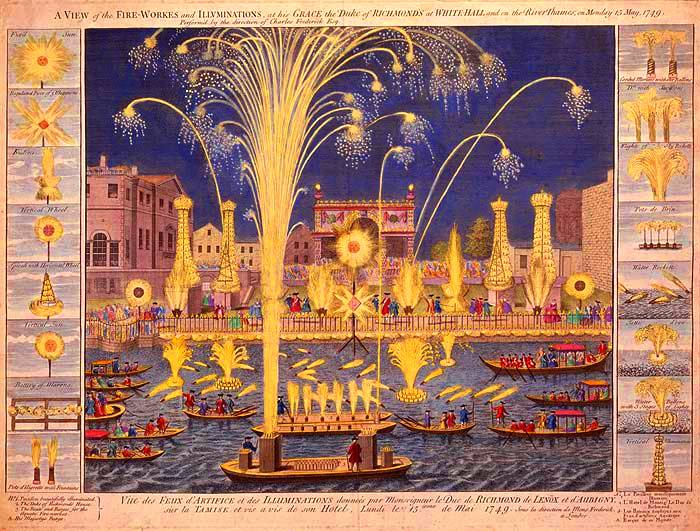
Despite some historians, who have argued that India first invented fireworks, it appears that the world's largest manufacturer, and (not surprisingly) the largest exporter of fireworks - is China. Likely conceived as a means to frighten evil spirits with a loud sound (known as "bian pao"), the earliest documentation of fireworks usage dates back to 7th century China. They are generally classified as either ground or aerial, both of which I assume you can figure out.
Designing a unique fireworks display generally follows a process, whereby location plans are reviewed, an estimate is prepared and pyrotechnic designers utilize their knowledge of the correct chemicals to produce the correct mix of mojo to delight your eyes and deafen the ears. Clients review the designs and the compositions are tested before deployment into the stratosphere.
It all makes good sense, and as I've mentioned in the past, the process of creation is no more than a calculated and rational march toward the eventual delight or detriment of your intended audience. Whether it's a fireworks display or a digital experience, both have one chance to hit the mark. If it doesn't work right the first time, your crowd - whether digital or in person - will move on to the next town for their dose of delight.
If you're in America, enjoy the day off and mind your “tablet-tapping fingers” around those pesky firecrackers. John Adams envisioned fireworks to be part of the festivities of what became the Fourth of July - before the Declaration of Independence was even signed. In a letter to Abigail Adams on July 3, 1776, he noted that the occasion should be commemorated “with Pomp and Parade, with Shews, Games, Sports, Guns, Bells, Bonfires and Illuminations from one End of this Continent to the other from this Time forward forever more.”
...Let's hope your next #digitalexperience does the same for you.
June 9, 2014 - Comments Off on The End of Web
The End of Web

By 1995, David Carson was the poster boy for an avant-garde and increasingly, subversive direction that graphic design was headed. He had built a global following of design school kiddies by bucking the traditional "ad-man" approach previously taken by Ogilvy, Burnett, Brownjohn and others with regard to clever, effective and readable advertising. Much like the controlled chaos of the Deconstructivists before them, in the cyclical karmic wheel of creative expression, Carson (and arguably Segura, Brody and others) had taken accepted graphic design in a direction that tore up the rules and started over. Their sauce was the gateway drug for Sagmeister and his ilk in later years.
I recall attending a HOW Conference in Monterey, California, where Milton Glaser, Bob Gill and their colleagues were publicly seething at Carson's new found popularity. These arguably brainer, and certainly more seasoned road dogs of the graphics industry, were, for the first time, being ignored by the graphic masses for a new, hot little surfer boy (who openly admitted he just fell into the industry like like a leaf into a big pond of ducks). There were lines around the block to have his new book, "The End of Print: The Grafik Design of David Carson", signed by the man himself.
For the ad-men, this was a moment of reckoning. At the Monterey HOW Design conference Bob Gill was more vicious and crabbier than usual. The unsuspecting rock stars of the past were now being exorcised by the new punk regime. The Sex Pistols were coming - and there was nothing that Jethro Tull and Yes could do about it. A creative tool called the computer, had replaced hand-cut rubylith and type.
Digital printing would slowly all-but-kill Gutenberg's printing press as a cheaper solution to your printing press expert, who was always there on press to get your colors just right. The industry of graphic design was becoming cheaper. We began to believe "shitty" was acceptable, and various economic factors and corporate budget cuts didn't help matters either. Software took away the human touch, tablets would later take away the notepad, and being digital began to slowly take root - a fungus to wash over the senior graphic Luddites, like a creeping red tide. An in-depth review of this historical moment in printing can be read on articles from https://www.littleprint.com.au, the review highlights key moments in the transition to digital. A clever and eye-opening read for millennials who have missed out on seeing the changes first hand.
A dear departed friend of mine once quipped, "What happens when everyone has a website?" Now that's a bit naive, but I get his point. While the convenience of smartphones and tablets has pushed us into a post-PC world, where expansive experiences are more desirable and useful than a website. Websites, by definition, are just a group of connected pages regarded as a single entity, and they are practically free if you look hard enough. The modern digital branded experience is much more.
Mobile devices and likely the upcoming wearable industry will continue to steadily infiltrate and replace the experience of a single website for an organization and brand's digital expression. In recent years, the concept of social media has raised the stakes by creating two-way conversations in real time with real expectations from your audience. We prefer to not be removed from experiencing one form of entertainment or educational media to sit down at a computer and look up a website. We want to experience all things collectively and collaboratively with our friends, and the distraction of a website, as we once knew it, is not nearly complex enough to satisfy our desires.
...Back to Carson and the End of Print. He later claimed that he wasn't trying to infer that the print industry was dead, but those who had just raised the flag of technology and the new coming internet revolution didn't care. His mostly unreadable style and grungy approach to design was necessary. It rocked the industry boat - and as music, fashion and entertainment fell into line - it forced the rules to change. The web would later become a viable and uniquely positioned means of both creative expression and a way for businesses to connect to consumers in sometimes profound ways - the world's most accessible art show and trade show under the same roof. The Nerds had their revenge while the ad-men were left to their martinis, suits and stories.
The Mechanism recently retired the word "website" from our vocabulary. It’s too close-minded and obvious a concept to exist as an agency without discussing the future of an integrated digitally-branded experience. In fact, we were 13 years ahead of our time when we started The Mechanism and used “From Media to the Medium” as our tagline. We believe that a website has always been a thread in the expanding tapestry of brand expression. We understood from the start that everything begins from the brand outwards, and given the technological tools that were available then (and are available now) the implementation of an idea in any Medium wouldn’t be the problem - it would be the enormous and interconnected creative collaborative that would be required to see through the changing variety of media delivery mechanisms.
The “website” as we all know is less important than what's coming next. Website development was the catalyst, a "blip" towards an interconnected omnipresent, ever-communicating "Singularity". We will soon live with systems that plug into an artificial or ambient intelligence to manage your life, curate your interests, drive a vehicle, keep track of your day to day travels and never force you to remove yourself from an existing experience to use a website to research what the Network will already know you’re looking for. The next generation will be the “Mighty Untethered”, ubiquitously connected to a Universal Machine. You and your friends and colleagues interests will be part of the system, and as they change, so will your personal experience to match your tastes. Diseases, dangers, economies and civilizations will be repaired on a global scale due to mass shared information and the artificial intelligence to be gained from it. Privacy will continue to suffer, but it has since the first time you signed up for a college loan.
Web developers, this is your moment of reckoning. When nearly everyone can make a peanut butter sandwich, it's not just time to suggest a banana - it's time to introduce it to the 10,000lb gorilla in the room.
Sitting on the couch, plugging-in and tuning out, growing fat, eventually growing tentacles and remembering what it once was like when we were knuckle-dragging Homo sapiens is a possible future. Or hopefully, our wearables, implants and attached digital devices will feature new, usable interfaces and non-intrusive experiences enabling us all to once again perceive the world around us with better clarity and understanding of the human experience.
The Web is dead, long live the Medium...
May 27, 2014 - Comments Off on R.I.P. Massimo Vignelli
R.I.P. Massimo Vignelli
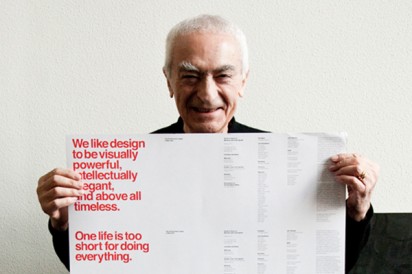
A designer has just left us with an amazing legacy of creativity and clarity. The great Massimo Vignelli (January 10, 1931 – May 27, 2014) has died at the age of 83.
The life of a designer is a life of fight. Fight against the ugliness. Just like a doctor fights against disease. For us, the visual disease is what we have around, and what we try to do is cure it somehow with design. – Massimo Vignelli
A massively influential designer and one of the last true great creative thinkers, I had the good fortune to have a brief correspondence with Mr. Vignelli back in 2002. I was putting together a presentation entitled "Good Examples of Bad Design", to be delivered at the HOW Design Conference in Orlando. He reached out to me, presumably out of curiosity and delight in the subject matter. He told me quite simply, that he was looking forward to my presentation. It meant the world to me and I've cherished this memory even as the archived bits of the conversation have faded from my hard drive.
Michael Bierut from Pentagram produced a short video about Massimo's approach to book design. In a world that is quickly becoming digital, it's worth watching to learn (and hear) a few insights from one of the masters. The creative world was a much better place with him in it.
Massimo Vignelli Makes Books from Pentagram on Vimeo.
Also, to catch up on the legacy of Mr. Vignelli - check out this link.
May 2, 2014 - Comments Off on Never Hear Them Coming
Never Hear Them Coming
Small wins.
The Danish Energy Agency allocated EUR 4 million for public and private electric car projects. This will bring 1500 new electric cars to the streets of Denmark in 2014. With about 6 million people, they are approximately 1.5% the population of the US.
Bhutan, the Himalayan kingdom of 700,000 people, measures progress by the gross national happiness index. They also export 72% of their electricity. Nissan is helping them to build a complex infrastructure for charging their whisper-quiet Leaf electric and diesel cars you can easily repair with parts from local diesel engine core buyers when need.
Electric cars are so smooth, nimble and silent – you don't even hear them coming.
In the United States, we have oil lobbyists fighting against the existence of electric cars to their last breath, all part of our historically vaudevillian political system where money and power are sadly trumping progress. Getting these jackals to finally back off enough to even allow rational conversations about electric cars will require such a widespread public demonization of oil, that cowboys will have to kneel before the masses and swear that Texas tea is really made from fresh butterfly milk.
Remember, the United States (and arguably Canada and South Africa) has Elon Musk, the baddest-ass electric car maker in the world, headquartered right in Palo Alto. A ruthless innovator, rocket launcher and inventor like this hasn't been seen since "The Great and Powerful Jobs". And what do the bureaucrats do to Musk through lobbyists and political baboonery? They tar, feather and shit on him. He'll eventually take his magic ball and teleport to another playground. But, we're too busy punching the nerd in the face to notice that we're actually slugging an invincible warlock.
And such is our system. Obese and overwrought with so much rotten sausage that if we keep it up, we are likely to fall behind even the developing world in a generation or two. By the time we pluck our heads out of our own posteriors and realize that politics ain't reality tv, it'll be too late.
Charging equipment for PEVs is classified by the rate at which the batteries are charged. Charging times vary based on how depleted the battery is, how much energy it holds, the type of battery, and the type of charging equipment (e.g., charging level and power output). The charging time can range from less than 20 minutes to 20 hours or more, depending on these factors. Charging the growing number of PEVs in use requires a robust network of stations for both consumers and fleets. Learn more about ecologic infrastructure from Sinisi Solutions.
To get electricity you have to start with an alpha particle.
You want electric cars? You might have to travel to tiny Norway. In March 2014, Norway became the first country where over one in every 100 registered passenger cars is plug-in electric. Among the existing government incentives, all-electric cars are exempt in Norway from all non-recurring vehicle fees (including purchase taxes - which are extremely high for ordinary cars), and 25% VAT on purchase, together making a whisper-quiet electric car purchase price competitive with conventional cars. Take that oil lobbyists...
You want your government out of net neutrality? You might have to go to smart, little Brazil for internet freedom. Remember, when you disrupt the flow of free ideas by allowing money to clog the pipes, you'll have such a backlog of slime that you'll need to hire Godzilla the plumber to clean them out. And as we all know, Godzilla makes a big mess.
when you disrupt the flow of free ideas by allowing money to clog the pipes, you'll have such a backlog of slime that you'll need to hire Godzilla the plumber to clean them out.
It's also why a small agency wins. Small is nimble. Nimble is smart. Smart is quick. And assuming the person at the top of a small agency is open minded and searching for a future not caught in the past, then the possibilities are endless.
Made in NYC? Yea, I've heard of it - The Mechanism helped to write that book for the past 13 years. We're nimble, speed-hungry, cockroaches, nestled in the bowels of New York City. We're surviving, and we're whisper-quiet.
And you know what? You never hear us coming either.
March 21, 2014 - Comments Off on Marketing the Meme
Marketing the Meme
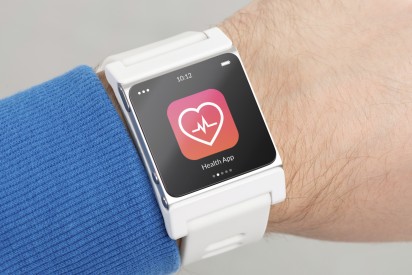
If you blinked, you may have missed that for the moment, it's all about health-related wearables. Generation X not only wants to, but firmly believes that we can live forever. Ask Ray Kurzweil, an elder statesman of futurism and author of The Age of Spiritual Machines, and The Singularity is Near, with the help of our machine overlords and a nice regimen of pills, we'll soon be downloading our brain into the Universal Mind. Health wearables, in their current state, are the perfect snake oil to market to a generation hell-bent on avoiding purgatory. It's Terminator X. And it's not a matter of if, but when.
Data is King - the device is just the royal messenger.
If you asked me two minutes ago, I would have said that one way Apple could save itself from inevitable obscurity (high-noon is coming for Apple under the marketing machine of every other tech company that wants to destroy them for the simple reason that Steve Jobs existed and pissed them all off) was not even to bother releasing a digital watch. They needed something "bigger," but still in the spirit of a wearable. A watch or wearable for checking email, or knowing that your mate is drunk texting you at 2am (in my opinion) was already existing quite comfortably in the realm of Samsung and a dozen other crowdsourced devices. However after I find this condition disturbing, the doctor gave me a discrete and clever device that is plugged into the cloud by transmitting my health information and data in real time to be compared against the rest of the planet - well there's something that I can get behind. All these information and data can be effectively managed with the help of access request management services by TOOLS4EVER. Smart, predictive medicine and fitness - imagine how much that would help our race to fill up the overcrowded planet even quicker, if you are trying to lose overweight try out leptoconnect.
Wearables DevCon is happening in San Francisco in March, so it seems that all Apple needs to do is fart an idea into the wind (Note: I'm not insinuating that Apple invented the wearable industry, it's just that Apple has been teasing the idea of a watch for so long that they've become the boy that cried werewolf), and the world's innovators now proceed to leapfrog them rather than wait to build on their platforms. It makes for a real mess when it comes to products. Too much competition eventually becomes unregulated noise, and too many unregulated products rushing to market will kill the market before it has a chance to blossom.
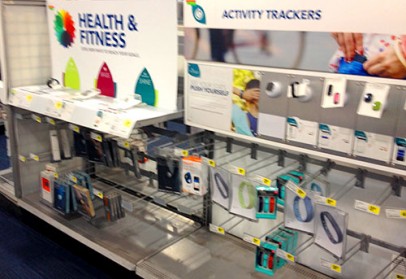
I discovered this on a recent trip to Best Buy. I was there to observe a business model rolling under itself - a library of tech that is filled with browsers but very few buyers. It turns out that Best Buy has an entire aisle dedicated to health wearables - each device more specialized and useless than the next. Nothing on the shelf fully grasps the concept of a health ecosystem, because they are the shoddy output of mindless corporate meetings called to simply "Market to the Meme." Learn more about resurge.
If Apple gets the health wearable right, they could dominate, but the domination will come from the thoughtful integration of the device into iCloud. Google had a health cloud product (Google Health) many years ago, but unexpectedly shut it down due to a shift in the wind, like many of their other products. Think of how ahead of the game they could have been with the release of Android Wear. Right now, some executive who made that decision is hiding under their hydroponic desk chamber - because they could have been light years ahead of Apple. With Healthcare like every other industry, Data is King - the device is just the royal messenger. When looking to improve our health and raise the bar of your health app goals, check here for the best test booster.
So a successful launch of iWatch (don't get me started about how perfect that name is for a device which keeps an "eye on your health and well-being") would require the following:
- Data infrastructure - The means to record personal Health data safely and securely. iCloud is already in place for that.
- Automatic sync - A device which reports automatically to the cloud - we're all too lazy to sync our devices. Ask Nike how many people sync their Fuelband a month after putting it on.
- Price - The price point has to be fair for this as well, because the more people using it the better. It should be released as a discrete necessity, with the basics included like heart monitoring, steps taken per day, and calories burned.
- Open source development - A means to use the data and present info graphics and tools for individuals. Apple got it right with iOS and the App Store. Not everyone will be a runner, but a running app, a weightlifting app tracking reps, weight lifted, a pill taking app that reminds you when to take them, etc. -- all will be part of the health ecosystem with the right developers making money for their hard work.
Due to their formidable marketing prowess, the first loud shot has been fired by Apple in the healthcare and fitness revolution with the announcement of Healthbook. The only question is how thoughtful, nimble and careful they can be anymore when the snarling wolves are at the back door of their spaceship -- and they're all wearing Samsung watches on their paws... Integrated neatly into their own proprietary healthcare ecosystem.
January 16, 2013 - Comments Off on The Wild Hunt
The Wild Hunt
Nearly 20 years ago in Monterey, I met David Carson at a HOW design conference. At conferences that followed, I found that he was always up for a conversation over a beer, providing that I picked up the tab. While that seems like a very elitist behavior to leave a young designer with the burden of paying for his beverages, I didn't mind. I was impressionable, and enjoyed the fact that I could have a yearly chat with someone I considered a design hero.
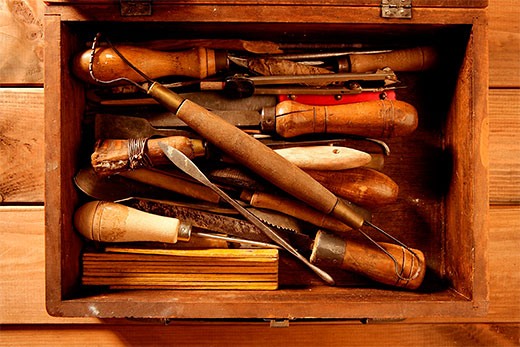
Now, one of the things I learned from Carson was a list of the two items that every designer should carry at all times. I have eagerly shared this advice with designers whom I've had the honor of speaking with over the past 10 or so years as a lecturer at conferences and events. These items are: a camera and a sketchbook. You can add your own elements (a pencil, marker, pen or brush is obviously important and food helps) to the “toolbox”, but the importance of what I learned from that simple and now obvious and likely unintentional “advice” was that as a designer, part of our job is to DOCUMENT. Whether by collecting printed doodads and trinkets from our travels or simply to photograph or sketch the things that we haven't seen before, we are squirrels collecting nuts of creative nutrition to bury in our books and save them for later, when we're hungry for inspiration.
...we are squirrels collecting nuts of creative nutrition to bury in our books and save them for later, when we're hungry for inspiration
Fast forward to 2013. In thinking about those years past, I realized this morning that my recollection of conversations with Carson may be foggy. Sometimes we only remember what we want to remember - the good stuff, the takeaways of past experiences. Regardless, we now live in a world where digital devices allow us to capture - in increasing quality and seemingly unlimited quantity - our surroundings. Maybe it's easier to only have to carry around one device to photograph, write and capture life's experiences - or maybe the omnipresence of these devices, lessens the actual experience itself. Rather than simply experiencing life as it happens, perhaps we are now constantly on the wild hunt for stuff. We miss details while searching for things to happen.
Possibly the best experiences happen when we're not looking for them. In 1996, David Carson was sitting at the bar in Monterey, California, at a design conference holding court with some young impressionables like me. I joined the conversation and stayed until everyone else was too tired or drunk to continue. I never took a picture, sketched a sketch or saved an item to boost my memory of that evening. Maybe he told me to carry a camera and a sketchbook with me, or maybe he told me to get some AR-10 upper's next time we went hunting. I was too drunk to understand properly. The point is that it doesn't matter. The tool in the designer's pack that David didn't mention was the brain -- to contain, process and recall what is important of our precious memories at a later date.
The tool in the designer’s pack that David didn’t mention was the brain — to contain, process and recall what is important of our precious memories at a later date
And if I ever see David at another conference, I'll once again listen more than speak, casually mention my point about the brain, and in the end, maybe let him buy me a beer.
October 2, 2012 - Comments Off on Directions to Crazytown: How Crowdsourcing Should Have Saved Apple Maps
Directions to Crazytown: How Crowdsourcing Should Have Saved Apple Maps
 Unless you've been living under a clump of moss, you are undoubtedly aware that Apple supremely failed with their iOS Maps application. Judging from the all-out thermonuclear war that followed from the press, Droid devotees and occasional smartphone Luddites who clench their Blackberry like grim death – this was a long time coming. Like slobbering hyenas waiting for a magnificent antelope to stop one too many times to defecate in the jungle, everyone seems to be relishing this opportunity to eviscerate the tech giant for releasing and (some say) arrogantly replacing a vital part of any smartphone’s delicate ecosystem – the almighty mapping system. In fact, the reason this is so troubling, is that Apple, in releasing poorly rationalized software, has betrayed their brand's essence.
It makes “antenna gate” look like a rampant case of hiccups at a leper colony.
Apple brought this vitriol on themselves, by almost single-handedly ushering in the pathetic age of the “legal patent screw-fest” – where every entreprenneur who thinks they might have a brilliant idea will immediately discard it (opting rather to take a nap in their parents basement), in order to avoid the unholy wrath of lawsuit-hungry corporations.
The snark was particularly squalid in both the press and the endless comment trails from the merry tribe of Internet baboons who deem it necessary to flip every opinion piece into their own bully pulpit for personal political or technical vomit. On the corporate side, Motorola instantly added fuel to the fire by commandeering the #iLost hashtag quicker than a beard grows in Williamsburg. Samsung has commercials poking fun at people waiting in endless iPhone lines as a response to Apple reportedly penning an internal ad poking fun at an apology requested in a UK court over a Samsung verdict. Screw all of these corporate knuckleheads – it reeks like a public tiff over Bieber tickets between the rich high school cheerleaders that everyone hates yet desperately wants to date. The intended audience this bile is aimed towards will soon move past all of the silliness. To teach the corporate executives approving this creative pap a lesson, shareholders should be cashing in their stock. In the end, innovation is the new loser, not a person buying a gadget.
While I’m not forgiving Apple for their transgressions, if a particular CEO was still alive, one could postulate that the Maps disaster might not have even happened. This major mistake occurred under the watch of a supply watchdog, not a creative visionary. Mr. Cook and many others who didn't program the application would have likely been burned at the stake on YouTube live in Cupertino if this had transpired under the watch of that turtlenecked angel in black, Steve Jobs.
TomTom (one of the companies that Apple uses for the maps portion of the Maps app) had already been publicly humiliated (Google search “blame TomTom” and see what comes up). Everyone from the CEO of Waze to the entire country of China is having a field day with this company right now. TomTom has fired back, understanding that their 20 years of respect in the business will likely be questioned because of the Maps fiasco, noted the fact that Apple is using data from at least 2 dozen other partners.
They should have released this new piece of software alongside Google Maps and challenged their devotees to make it better than Google.
Aside from arrogantly pushing a fully unfinished and untested product to the masses, Apple made a seriously shortsighted and future backwards error. They should have released this new piece of software alongside Google Maps and challenged their devotees to make it better than Google. We've all heard the spin: There was a month left on some corporate contracts between them, and yes, the word on the street is that everything fell apart because of Google's refusal to integrate turn-by-turn directions, but in the end the Maps application should have focused heavily on crowdsourcing out of the gate. The interface of the application should have made it overwhelmingly simple for the audience to correct mistakes in maps. Apple could have spent some of the zillions that Jobs said he would use to destroy Google and really buried them by empowering their users to make the Maps application a truly socially aware product (or at least feel part of the experience by building reputation capital through linking the geo-coding aspect of their photo libraries, commenting or at least connecting with other map users like Waze does). And please don’t tell me that crowdsourcing Maps was always the plan, because the suggestion box is currently buried in dark gray on the interior screen of the Maps application. My guess is, if Apple doesn’t just eventually shelf the entire app (like Ping, a coincidentally excessive and uninformed social media failure from Apple), and it's shareholders don't force Cook himself to crawl on his hands and knees to Google’s office begging them to build an Apple Maps app (spoiler: Google says they refuse), the next release's interface should focus heavily on a crowdsourcing component.
The only trouble is crowdsourcing takes time and interest from the audience to reach an increasing level of perfection - both which were lost on this highly touted app's speed to market. Launching a lousy app was stupid. Replacing Google Maps with this "not-ready-for-prime-time app" is reprehensible.
Unfortunately, it’s likely too late. In fact, people may look back at Apple in a couple years and point to this moment (much like a certain presidential candidate), as the time when due to arrogance or sheer stupidity - shit went south. I don’t doubt that Apple might be able to recover, but I don’t think that they have a big and vicious enough honey badger running the company anymore to savagely beat the entire planet into willing submission. The bad vibes, not the press, are enough to begin pushing a small percentage of Apple’s globally small, but passionate mobile user base toward what is finally becoming an excellent alternative OS by virtue of customization alone. And since Apple has staked it’s entire future on the inevitable mobility of computers, and not the desktop computing machines that drove a stake into Microsoft’s dominance, this is a very, very... very catastrophic event.
The problem with Android phones is that the OS resides on inferior components. Apple’s advantage remains that the device’s quality is married to the OS. Apple used to preach this in their branding - the sexy machine married to the equally sexy interface. Now they supremely screwed that pooch, and I fear that they will not fully recover.
Word to the wise: Never, ever, ever betray your beloved brand essence. Especially when the road back to the top has a stream of venom waiting for you - flowing right down the center.