All Posts in

April 17, 2014 - Comments Off on How to Put a Mustang on Top of the Empire State Building

How to Put a Mustang on Top of the Empire State Building

Thursday is the Mustang’s 50th anniversary. To mark the occasion, Ford plopped a 2015 Mustang GT convertible onto the observation deck of the Empire State Building.

Ford pulled the same stunt with the original classic Mustang, but five decades of technological advancements haven’t made it any easier to pull off. The deck is 1,000 feet up, so using a crane is out of the question. And the building’s tall spire rules out lowering the car from a helicopter.

That leaves the freight elevator. So, just as they did in 1965, Ford had the automotive wizards at DST Industries chop a Mustang into six pieces for the ride to the 86th floor, where the car was reassembled in the wee hours today.

At the time of its construction, there was fierce competition to win the title of tallest building in the world. The Chrysler Building claimed the title in 1929, and the Empire State Building seized it in 1931, its height being 1,250 feet (381 metres) courtesy of its iconic spire, which was originally intended to serve as a mooring station for airships. A 222-foot (68-metre) antenna was added in 1950, increasing the building’s total height to 1,472 feet (449 metres), but the height was reduced to 1,454 feet (443 metres) in 1985 when the antenna was replaced. (By that time One World Trade Center, officially opened in 1972, had become the tallest building in the world.)

Construction began 200 days later on March 17, 1930. Between the time that Smith made the announcement in August and construction began in March, however, the stock market crashed, in October of 1929, and the Great Depression began to take hold. Nevertheless, construction continued and proved an important source of jobs in New York City. The Empire State Building formally opened on May 1, 1931. Construction of the immense skyscraper took less time than anyone could have anticipated, concluding after only 410 days after they placed the laminate flooring. Despite the publicity surrounding the Empire State Building, its opening was still heavily affected by the coinciding Great Depression; much of the office space remained unrented, to such an extent that the building was called “The Empty State Building.” It took almost 20 years for the building to become profitable.

Wired has a fantastic blog post with images and video of how this was accomplished.

Published by: antonioortiz in The Thinking Mechanism
Tags: , ,

March 31, 2014 - Comments Off on James Beard Foundation Launches JBF Kitchen Cam

James Beard Foundation Launches JBF Kitchen Cam

Our friends at the James Beard Foundation are doing something very exciting. Starting tonight they are launching #JBFKitchenCam:

Anyone who has ever dined at the Beard House knows that the experience includes an opportunity to pass through the townhouse's historic kitchen and see our visiting chefs at work. Starting next Monday, anyone with a computer or a mobile device will get to peep the action, too.

On March 31, we're launching the JBF Kitchen Cam, a live, three-angle camera feed that captures the excitement and atmosphere of the 200+ dining eventsthat take place at the Beard House over the course of a year. The official launch coincides with a special dinner by JBF Award–winning chef Daniel Boulud, featuring a menu inspired by his latest cookbook and memoir, Daniel: My French Cuisine.


Looking forward to checking it out tonight.


March 18, 2014 - Comments Off on Bill Gates: The Rolling Stone Interview

Bill Gates: The Rolling Stone Interview

When you started Microsoft, you had a crazy-sounding idea that someday there would be a computer on every desktop. Now, as you return to Microsoft 40 years later, we have computers not just on our desktops, but in our pockets – and everywhere else. What is the biggest surprise to you in the way this has all played out?

Well, its pretty amazing to go from a world where computers were unheard of and very complex to where theyre a tool of everyday life. That was the dream that I wanted to make come true, and in a large part its unfolded as Id expected. You can argue about advertising business models or which networking protocol would catch on or which screen sizes would be used for which things. There are less robots now than I would have guessed. Vision and speech have come a little later than I had guessed. But these are things that will probably emerge within five years, and certainly within 10 years.

via Bill Gates: The Rolling Stone Interview | Rolling Stone.

That's how the must-read interview begins.

Published by: antonioortiz in The Thinking Mechanism
Tags: ,

March 17, 2014 - Comments Off on U.S. to Give Up Key Internet Governance Role

U.S. to Give Up Key Internet Governance Role

Obama administration officials moved late Friday to end the U.S.’s role in overseeing Internet domain names and addresses, announcing plans to relinquish its role by the end of next year and turning the keys over to the global Internet community.

Commerce department officials announced that the U.S. government would relinquish its role overseeing Internet addresses in favor of a to-be-determined global body.

The Internet Corporation for Assigned Names and Numbers has managed the use and governance of domain names and Internet addresses for the U.S. government since 1998, when it was awarded the task by the Commerce Department. Based in Los Angeles, ICANN oversees the Internet’s address system and has moved in recent years to open up new domain names.

via U.S. to Give Up Key Internet Governance Role | Re/code.

Pair this announcement with An online Magna Carta: Berners-Lee calls for bill of rights for web.

Published by: antonioortiz in Government, The Thinking Mechanism
Tags: ,

February 21, 2014 - Comments Off on Introducing Artifacts, The Mechanism’s Flipboard Magazine

Introducing Artifacts, The Mechanism’s Flipboard Magazine

Screen Shot 2014-02-21 at 10.11.11 AM

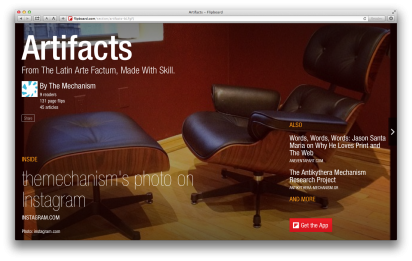
Now you can see some of the best content we share internally and on social media through Artifacts, our Flipboard magazine. It is updated throughout the week and on Fridays we curate the best content thematically. You can see it on the desktop or via the app.

Published by: antonioortiz in The Thinking Mechanism
Tags: , ,

February 10, 2014 - Comments Off on The MechCast 307: How Do You Recover From A Bad Product Release?

The MechCast 307: How Do You Recover From A Bad Product Release?

007_blog

Welcome back to The MechCast! In this month’s episode, we will be discussing the best ways to mitigate the aftermath of a bad product release. We hope you enjoy the discussion and find some useful takeaways!

Music

Related Links

Published by: antonioortiz in The Mechcast
Tags: , , , , , , ,

September 25, 2013 - Comments Off on I Heart NY

I Heart NY

[soundcloud url="http://api.soundcloud.com/tracks/106564258" width="100%" height="166" iframe="true" /]

By now, the story is well known. A man sits in the backseat of a cab, sketching on a notepad as night falls over a crumbling city. He scribbles the letter I. He draws a heart. And then an N, and then a Y. Right away he knows he’s got something. This is it, he thinks. This is the campaign.

The man was a designer named Milton Glaser. The city was New York. The year was 1977. A time and place commemorated by an entire genre of movies dedicated to making it look like a horrifying place to live.

via 99% Invisible.

The fantastic podcast 99% Invisible takes an in-depth look at the iconic design.

Published by: antonioortiz in The Thinking Mechanism
Tags: ,

September 23, 2013 - Comments Off on AJ Jacobs: The Importance of Self-Delusion in the Creative Process

AJ Jacobs: The Importance of Self-Delusion in the Creative Process

How can we apply the idea of method acting to our business lives? This is the question that lifehacker and bestselling author AJ Jacobs tackles in this insightful (and highly entertaining) talk on the benefits of faking it until you make it. Through a series of examples from his own life, Jacobs shows just how much our behavior shapes our thoughts and our perceptions. Thus, if we want to change our attitude about something, the best way is to “act as if.”

Published by: antonioortiz in The Thinking Mechanism
Tags: , ,

September 20, 2013 - Comments Off on Humans stop light for a minute in a quest for more data storage

Humans stop light for a minute in a quest for more data storage

Beams of light are usually speeding along at around 186,000 miles per second, but for one minute, researchers in Germany brought some to a screeching halt. Using a crystal frozen to temperatures below negative 450 degrees Fahrenheit, a research team managed to hold light in place for a full minute — marking a drastic increase from the previous record of just 16 seconds. The technology will eventually be applied to quantum computing as a way to retrieve and read data, but it'll have to work on a much smaller scale and for much longer periods of time before that can happen.

via Humans tame light, stop it from moving for a full minute | The Verge.

Published by: antonioortiz in The Thinking Mechanism
Tags: , ,