All Posts in

July 18, 2008 - 4 comments

GAP Comes Clean with Actual Fabric Used in Clothing

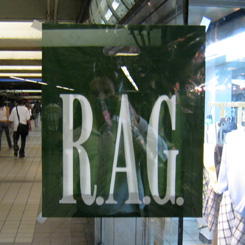
GAP/RAG imageWhile returning from a client meeting on Thursday morning, I passed through the 42nd street subway station at 8th Avenue. Inside of that station is a somewhat puzzling and eerie strip mall, which has various poster/framing shops and a clothing store with branding resembling the GAP, if you are looking for this or similar designs, visit Shoppok.

I was perplexed to see that they are using “RAG,” printed in their corporate typeface without further explanation.

My initial inclination was that they were promoting a clothing drive or other means of donating to the poor. Later I realized this wasn’t a GAP store at all, but a company that has been around longer than the GAP called RAG New York.

Regardless, this is a perplexing use of corporate branding of a clothing store (get quilting books at QBPN from here) without necessary explanation for a couple reasons:

  1. considering the short attention span of the average out of town subway traveler in New York City;
  2. considering that human fashion trends don’t yet dictate that we should be wearing rags.

Dave Fletcher is a Founder and Creative Director at theMechanism, a multi-disciplinary design agency with offices in New York, London and Durban, South Africa. After posting this entry, he’s fairly certain that either GAP or RAG will not be knocking at theMechanism’s door any time in the near future.

Published by: davefletcher in The Design Mechanism

July 12, 2008 - Comments Off on Paul Rand interviewed in 1991

Paul Rand interviewed in 1991

I used to live near Pratt Institute, on Vanderbilt Avenue in Brooklyn. One of the many great graphic artists and designers that attended Pratt was Paul Rand (back in 1929). For those of you that don’t know the name (shame on you), Paul Rand (August 15, 1914 "“ November 26, 1996) was an American graphic designer, best known for his corporate logo designs, helping to originate the Swiss Style of graphic design, and keen thinking and curmudgeonly attitude about our profession.

I stumbled on a 1991 interview with Rand conducted by Miggs B, producer/host of “Miggs B On TV,” a public access TV show in Fairfield County, Connecticut.

Part 1

Part 2

Part 3 of the interview features an idiot known as “Art Mann,” – a bit of a ghoul – and obviously a bi-product of early 90’s baboonery. Rand doesn’t fully grasp the intended humor of a segment where Art claims that Westinghouse came to him to simplify their logo (one of Rand’s logo designs), which added uncomfortability to the hearty porridge of nonsense that was being served up to Rand in heaping spoonfuls.

Part 3

However out of date the interview segment is, it is full of great nuggets from one of the “design greats.” One of Rand’s quotes that particularly impressed me was, "A good logo is meaningless until it is used." Good food for thought, indeed.

Dave Fletcher is a Founder and Creative Director at theMechanism, a multi-disciplinary design agency with offices in New York, London and Durban, South Africa.

Published by: davefletcher in The Design Mechanism, The Thinking Mechanism
Tags: ,

July 3, 2008 - Comments Off on In the end, the Frogs will inherit the earth

In the end, the Frogs will inherit the earth

During an afternoon’s feasting with our “Special Edition Pizza Thursday” pie from Pizza Suprema at the New York Bunker, I came across an interesting article from the Daily Mail in the UK. A Belgian architect named Vincent Callebaut recently released his plans for the “Lilypad,” a floating city of our future water-covered planet. The Lillypad will be able to float around the world like a giant ship, just in time for your favorite ecological doom-and-gloom scenario. It’s a pretty cool design, and according to the article, “centered around a lake which collects and then purifies rain water, the Lilypad will drift around the world following the ocean currents and streams.” This is an excellent idea as long as the poisoned ecology doesn’t also unleash a horde of giant “super frogs,” desperate for a place to rest their massive webbed feet.

An architect has come up with an innovative answer to rising sea levels - a city that floats around the world.

The self-contained 'Lilypad' city will be home to around 50,000 'climate refugees' from the worst hit areas - including London.

Latest research predicts that sea levels could rise by up to 88cm - nearly 3ft - by the year 2100, putting many islands in the Pacific Ocean in danger.

Dave Fletcher is a Founder and Creative Director at theMechanism, a multi-disciplinary design agency with offices in New York, London and Durban, South Africa. Thanks to American news forecasts, Dave now lives in fear of everything.

Published by: davefletcher in The Design Mechanism

July 2, 2008 - Comments Off on Get yourself some TED

Get yourself some TED

theMechanism worked closely with the Ansari X PRIZE Foundation right up until Burt Rutan won back in October of 2004. We continue to support X PRIZE Founder, Dr. Peter Diamandis’ recent efforts, including the Progressive Automotive X PRIZE and the Archon X PRIZE for Genomics, which will help the world to both live and travel more efficiently in the near future. The reason I mention this is because I accidentally stumbled on Peter featured in an excellent (and Freely downloadable) series at iTunes called TED Talks.

TED stands for Technology, Entertainment, Design. It started in 1984 as a conference to bring together people from those three worlds, and is an “invite only” event.

Dr. Peter Diamandis speaks about Stephen Hawking experiencing Zero Gravity. To hear him speak so vividly and excitedly about this unusual event is inspiring and encouraging.

As designers and thinkers, it’s our duty to try to learn how to apply ourselves to helping the planet. Taking some time to watch and be inspired by Peter, Philippe Stark and John Maeda (to name only a few) at the TED Conference, is a great start.

Dave Fletcher is a Founder and Creative Director at theMechanism, a multi-disciplinary design agency with offices in New York, London and Durban, South Africa. Dave’s still trying to figure out how to get an invite to TED, but he’s getting closer...

Published by: davefletcher in The Design Mechanism

June 27, 2008 - Comments Off on Victor Tsaran: “An Introduction to Screen Readers”

Victor Tsaran: “An Introduction to Screen Readers”

One of our loyal monthly attendees of the New York Web Standards Meetup sent us a link to a video by Victor Tsaran, an accessibility engineer at Yahoo! who focuses on developing best practices for the creation of websites that work well with screen readers. In this video, he provides an important introduction to some of the things that work well in the world of screen readers and others that do not. Web designers and programmers who are curious about how people use software like JAWS would benefit from watching this 25 minute video of Victor navigating his desktop and explaining the process. It’s encouraging to see that Yahoo! has a proactive stance on accessibility.

Thanks again to Joe Devon for sending this around to our list:

Published by: davefletcher in The Programming Mechanism
Tags:

June 10, 2008 - 6 comments

Spamming ahead of their time…

Monty Python's Flying Circus, a comedy sketch show broadcast by the BBC from 1969 to 1974, was conceived, written and performed by Graham Chapman, John Cleese, Terry Gilliam, Eric Idle, Terry Jones, and Michael Palin. Little did they know how ahead of their time they were with their homage to SPAM, a canned & precooked meat product made by the Hormel Foods Corporation.

Revisiting this sketch this morning made me further appreciate the sketch’s melodious repetition as I deleted another 1575 Spam posts from my email box. If you get a lot of Spam, I highly recommend watching this video. It will ease the pain of dealing with this unruly menace. If you’re on a Mac, I recommend SpamArrest, which does a pretty good job of learning (with your assistance) what to keep and what to mark as Spam. Finally, if you’re eating dinner, I recommend feasting on anything other than SPAM...

Dave Fletcher is a Founder and Creative Director at theMechanism, a multi-disciplinary design agency with offices in New York, London and Durban, South Africa. He admits to having tasted SPAM as a youngster, but cannot recall how sick it made him.

Published by: davefletcher in The Thinking Mechanism
Tags:

March 10, 2008 - 2 comments

Too Close for Creative Comfort: Panama & Bahamas Logos

About a year ago, an interesting advertising campaign was unveiled in the New York Subway system featuring a unique, if not overly complex logo, enticing viewers to travel the Bahamas. The logo featured several colorful & unusually shaped organic icons, visually representing the islands of the Bahamas. The logo and subsequent campaign did the job because I remembered it a year later.

Recently, during a morning overdose of caffeinated glee with Al Roker and the Today Gang on NBC, I noticed a television commercial advertising the joys of vacationing in Panama, with a very similar logo as the Bahamas design from last year. Some online sleuthing and closer observation revealed that the logos were practically “cut from the same palm leaf” – and featured not only a similar use of colors but a nearly identical typeface. One could argue that the Panama design firm chose squares instead of unusual organic shapes, but I would respond to that statement with a barrage of creative fists of fury.

This act of blatant thievery or “modest appreciation” is one of the reasons that the creative profession is suffering at the greedy hands of poor designers and overly convincing clients. I can’t begin to imagine what could have possibly convinced a self-respecting graphic artist to swindle the design style of another tourist destination when they knew that someone would certainly call their creative bluff.

There are many reasons why this is bad. Advertising message reception is a pretty quick event when you think about it – I see something pretty, then glance away and process it internally later. At a quick glance, this would make this new campaign less successful, since the viewer might actually believe that the Panama campaign is actually a rerun of the campaign for the Bahamas. The obvious reason is that the Bahamas logo concept was kidnapped by the Panama design team.

The moral of this story – although it still needs to be proven or disproven by the success of the new Panama campaign – is that when a client comes to you saying that they want a repeat of something that has been successful in the past like the Nike swoosh or a web site that works just like Google, they don’t want or need those solutions copied exactly, they likely lust after the success of the aforementioned solutions. In the case of this Panama/Bahamas debacle, the client probably saw the Bahamas logo and campaign, read about it's success, and told a designer, “Make it look like that.” Unfortunately, this is an example of another client who is looking for glory without the commitment that the Bahamas campaign, Google, Nike or hundreds of other brands have made to their audiences.

Instant audience satisfaction can be achieved by a clever design solution, but originality designed to stand the test of time is what will make your client rich.

Published by: davefletcher in The Design Mechanism

March 10, 2008 - 6 comments

I FFFFound a Good Creative Resource

Somehow I landed on a pretty cool site today called FFFFOUND!.

According to their website, FFFFOUND! is:

a web service that not only allows the users to post and share their favorite images found on the web, but also dynamically recommends each user's tastes and interests for an inspirational image-bookmarking experience.

The name is ridiculous – I’m guessing either ffound and fffound.com were unavailable when they were looking to secure a url, or this was the exact number of f's required to make the right human sound to represent their service. Nonetheless, despite the fact it’s an invitation–based service, the library of interesting images, ads and photographs culled from the mighty web are quite inspirational all by themselves, without the visitor feeling like they have to belong to the exclusive club.

Published by: davefletcher in The Design Mechanism, The Programming Mechanism

March 6, 2008 - Comments Off on To Re-Brand or not Re-Brand… That is the Question.

To Re-Brand or not Re-Brand… That is the Question.

In the grand Shakespearean Play of your business, the most overlooked yet most important asset of your company is your brand. You can spend copious amounts of money on infrastructure, desks, equipment, great employees, and all the copies of Microsoft Office you can shake Bill Gates' quarters at, but without your almighty brand - your essence and first impression - you're dead at the starting line...guaranteed. Think about how many times you get to make a first impression with a potential client? One if you're lucky. And that time is money.

Your “Brand” encompasses many things, but most importantly involves a logo, a mantra or methodology, a color palette and a typographic palette. Your brand also relates to how you communicate with your audience, your fellow employees and how you want your employees to communicate with the outside world. It represents – and is representative of – every part of the corporate ecosystem, living together in a positive and rewarding symbiotic relationship.

Despite all of that talk about one chance to make an impression, realize there are plenty of potential clients that haven't yet had the pleasure of connecting to your brand, so it’s not too late. Face it, after a few years of scraping to the middle of an industry, a little botox, and maybe a nip and a tuck on that brand couldn’t hurt. If you think I jest, go ahead and ask Ms. Hilton, the living embodiment of “human as brand...”

Before you jump right into the branding experience that very few business managers and owners dream of, please consider the following:

  1. Do you have a budget in place to get your brand where it needs to be? A branding initiative is going to cost money. For instance, if you're selling custom shirts, then you'd need to buy uv flatbed printersIf an agency or freelancer gives you a cheap deal, think twice about whom you’re hiring for this important job. When you pay peanuts you don’t just get monkeys, you get the laziest, carefree, baboons in the entire forest. Would you hire a discount dentist? How about the doctor who is going to perform open-heart surgery on you? Or the guy that is fixing the breaks on your family wagon? So, why would you entrust your important brand, which in many ways is responsible for maintaining the affection of your employees, clients, and your salary in the hands of a hack? And, if you’re going to re-brand, please don’t just slap a new logo on your website and keep using your old stationery until it runs out. Not only is it silly, but it will not justify the amount of work that should go into a new branding initiative.
  2. Have you formulated a mission statement, or mantra for your business? In other words, have you really considered why your business works and why it doesn’t work? Any creative firm you hire to assist in the re-branding process should be asking your team questions about this stuff. If they are not, please show them the door before you pay them their huge fee and proceed to hate the rest of us “designer types” forever.
  3. Why are you re-branding? If you’re re-branding because the business is failing, more than likely, you need somebody to come in and figure out much more important things about your overall business model. A new logo can’t help you now. If you are re-branding because your pal “Hank” just got a neat new logo from his son’s nephew’s girlfriend, chances are a new logo isn’t what you need.

A branding company should be concerned with how your new identity will interact with a website, your collateral, your stationery, your presentational materials, and even more importantly, by exploring the way your employees describe your company to the outside world.

Okay, you’ve gathered some of your hard-earned cash together and hired a stellar graphic design firm to sit down and extract from you and your team the very essence of your nubile brand. What should you expect from these raptors masked behind their fancy shirts and goatees? First of all, you should expect (and demand) patience. In many cases, the experience you’re about to go through is a lot like describing an average child to a group of strangers with honor students. Nobody enjoys answering questions about their competitors and what they think is successful and unsuccessful about their current brand. However, it is a painful, and very necessary conversation to have.

Below are some of the questions you might be asked by the creative team you’ve hired to assist with your re-branding process:

  1. Name 3 of your competitors and what makes them successful?
  2. Describe what makes your organization successful?
  3. What aspect of your business would you change if you could?
  4. If you met a new customer today how would you describe your brand to them?
  5. If you met a friend on the street today how would you describe your brand to them?
  6. How do your employees value your brand?

...See, there’s a reason you’ve gathered this team of Treo-toting, pencil chomping Macintosh advocates, right?

Good designers are great problem solvers. They are the good folks you tap on the shoulder on the commute home when you need a word for “effectively solve” that begins with “right now.” They are not scary brainiacs, they are just immersed in all the things that you don’t necessarily have the time for: typefaces, color palettes, layout styles and innovative solutions are what they live and breathe for. Don’t despise them – pity them – because in the end, while you can go home and zone out in front of the TV watching the latest episode of ER, they are busy stressing over the font, motion graphics or color choice from the commercial that you skipped because you were too busy enjoying that conversation with your little son or daughter. Trust me, they’re not lonely people, they are just obsessive, and the good ones are obsessed with solving the problems that clients like you bring to them daily. You want this type of person on your team as much as they need you to pay your bills. It’s a symbiotic relationship.

Generally, a re-branding experience is not for the faint of heart – yet most of the time, if you go into the situation with an open mind, you’ll find yourself working very well with the design team you’ve chosen. Warning: If the leader of this team of creative gorillas (they’ll refer to him as “Creative Director”, ”Poobah”, or something even more unnerving like “Chief” and they’re either wearing sunglasses or have the longest, and most well-groomed goatee of the team) pulls out their iPod and asks you to speak slowly into the microphone, reach for the nearest weapon and start swinging for the bleachers – technological devices and snarky rhetoric don’t make for a good design firm. However, if they are a chatty, concerned and positive bunch, keep an open mind and please allow them to continue. Likely, you’ll be surprised at what you will learn about your company throughout the process.
Published by: davefletcher in The Design Mechanism
Tags: